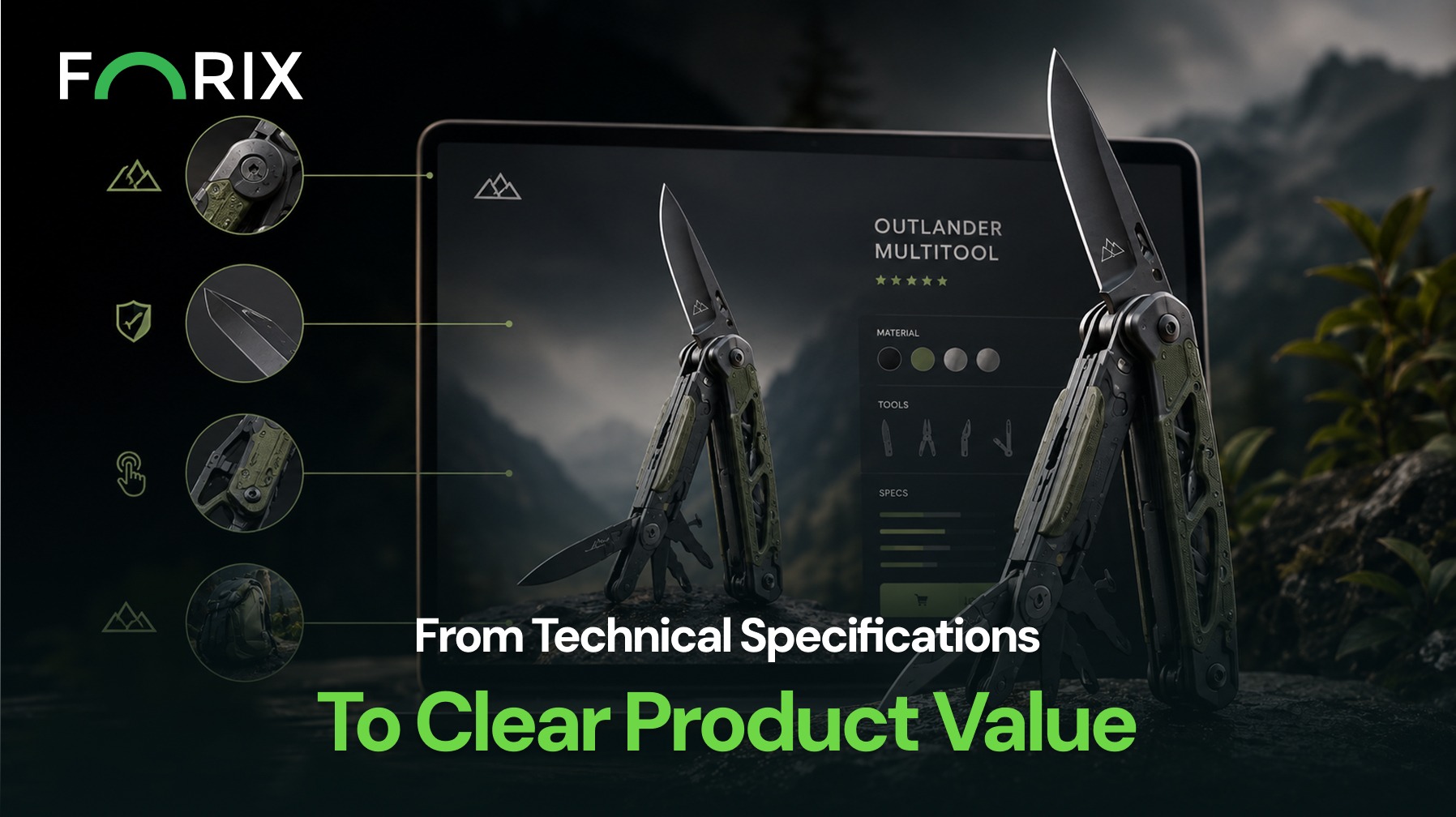
Complex products often need detailed specifications. Dimensions, materials, mechanisms, compatibility, and performance features help informed shoppers compare options. However, specifications alone do not always explain why a product matters or which customer it serves.
A leading outdoor tools manufacturer faced this challenge across its eCommerce experience. The catalog included innovative knives and multitools with meaningful technical differences, but shoppers also needed to understand the craftsmanship, intended use, and design thinking behind each product.
The Challenge: Strong Products, Difficult Evaluation
The brand had strong recognition, experienced designers, and products built around innovation. Its website still needed to help customers understand what made one option different from another.
A shopper could review blade materials, handle construction, dimensions, locking mechanisms, and opening systems. Yet those details did not automatically answer practical questions:
What is this product designed to do?
Which features matter for my intended use?
Why is this option different from a similar model?
What supports its price and quality?
Who designed it, and what problem were they solving?
When the experience placed too much responsibility on specifications, shoppers had to translate technical language into personal value by themselves.
Building the Product Story Around Shopper Questions
Forix approached the experience from the shopper’s perspective. Technical data remained important, but it needed a clearer hierarchy.
The strongest product storytelling began with the information customers could understand quickly: the product’s purpose, defining benefit, intended user, and most meaningful differentiator. Detailed specifications then supported those claims.
This created a more natural sequence:
Introduce the product’s role or use case.
Highlight the feature that makes it distinctive.
Explain the practical benefit of that feature.
Support the explanation with technical specifications.
Give interested shoppers access to deeper detail.
The structure helped experienced customers find precise information without forcing every visitor to begin with terminology they might not understand.
Showing Craftsmanship Instead of Only Describing It
Product value was also communicated visually. Large, high-quality imagery brought materials, construction, and design details closer to the shopper.
The experience gave customers a stronger view of how the products were created. Designer stories and interviews provided context around the creative process, reinforcing the innovation and artistry behind the catalog.
This content did more than add brand personality. It helped customers understand that product details were deliberate choices connected to function, quality, and use.
For complex or premium products, this distinction matters. A specification can state what a product contains. Strong storytelling explains why that decision creates value.
Making Comparison More Meaningful
Clear product value also improves comparison. Shoppers should not need to compare long tables of nearly identical attributes without guidance.
Forix helped organize browsing around meaningful differences. Stronger visual hierarchy, clearer category experiences, and richer product storytelling made it easier to identify which products deserved closer consideration.
Effective comparison content should prioritize:
The attributes that change suitability or performance.
Differences customers repeatedly ask about.
Benefits associated with materials or mechanisms.
Intended environments, tasks, or user needs.
Tradeoffs between similar options.
This approach reduces information overload while preserving the technical depth buyers expect.
The Business Impact
The changes formed part of a broader redesign and continued optimization program. Following that work, the brand achieved a 25% increase in average order value, a 51% increase in transactions, and a 92% increase in online revenue.
These results should not be attributed to specifications or storytelling alone. They reflect the combined impact of clearer browsing, stronger visual presentation, better product discovery, and an experience designed around customer decisions.
The case demonstrates a broader lesson: technical information creates more commercial value when shoppers can connect it to purpose, quality, and personal relevance.
Conclusion
Complex products do not need less information. They need information presented in a more useful order.
Forix helps eCommerce retailers combine technical detail, visual storytelling, and conversion strategy to make product value easier to understand. When shoppers can see what a product does, why its features matter, and how it differs, they can evaluate options with greater confidence.
Why are technical specifications not enough for complex products?
Specifications describe product attributes, but they may not explain how those attributes affect practical use, performance, suitability, or value. Shoppers need both technical detail and benefit-focused context.
How should retailers organize product specifications?
Retailers should begin with the product’s purpose, key benefit, intended user, and main differentiator. Detailed specifications can then support those points in a structured, scannable section.
How can imagery communicate product value?
High-quality imagery can show materials, construction, scale, details, and products in use. This helps customers understand quality and craftsmanship more easily than text alone.
What product differences should comparison content prioritize?
Comparison content should focus on attributes that affect suitability, use, performance, compatibility, quality, or price rather than presenting every available specification with equal emphasis.
How should retailers measure stronger product storytelling?
Retailers can review product engagement, comparison activity, product-page exits, add-to-cart rates, average order value, transactions, conversion rate, and revenue.
From flat sales to explosive sales growth - here's what happens when you partner with Forix
Partnering with Forix was hands down the best decision I’ve made for my store. The
redesign completely
transformed my site — it looks like a million dollars, yet I paid only a fraction of
what I expected.
Even better, sales started climbing almost immediately. Their process was simple,
transparent, and
focused on results. I only wish I had done it sooner.
Sarah Mitchell,Owner
“The free website report from Forix opened our eyes to issues we didn’t even know were costing us sales. The recommendations were clear, actionable, and backed by data. After implementing just a few of their suggestions, we saw a noticeable lift in conversions within weeks. Forix didn’t just give us a report—they gave us a roadmap to growth.”
Lena Hoffman, Director of eCommerce
“The redesign was exactly what my business needed. Clean, mobile-friendly, and conversion-focused. Sales are up 35% since launch.”
Ethan Carter, Founder
“Forix made our Magento to Shopify migration completely stress-free. Every product, customer record, and integration was moved accurately, and the new store’s design is sleek and user-friendly. Our team can now focus on growing sales instead of worrying about technical issues.”
Emily Rivera, Head of Digital Operations
198%
Conversion increase
32%
Transaction increase
30%
Time on site increase
28%
Conversion increase
92%
Revenue increase
87%
Engagement increase
Ready to See the Difference?
Your next big sales boost could start with our free website report. Let us show you the
untapped
potential in your store.
Complete the form below and our team will reach out to get started.
Thank you!
We’ve received your request for a free website report. Our team will be in touch shortly to gather a few details so we can begin your site analysis.
Click Here To
Get My Free Website Report Now
Claim Your FREE Webpage Design and Sell More ASAP
Complete the form below and our team will reach out to get started.
Thank you!
We’ve received your request for a free webpage design. Our team will be in touch shortly to gather a few details so we can begin your page redesign.
Click Here To
Get My Free Webpage Design Now
Claim Your FREE Migration Assessment and Sell More ASAP
Complete the form below and our team will reach out to get started.
Thank you!
We’ve received your request for a free Magento-to-Shopify migration assessment. Our team will be in touch shortly to gather a few details so we can begin building your comprehensive migration plan.
Click Here To
Get My Free Migration Assessment Now
Claim Your FREE Site Report and Sell More ASAP (a $2,000 value).
Complete the form below and our team will reach out to get started.
Thank you!
We’ve received your request for a free website report. Our team will be in touch shortly to gather a few details so we can begin your site analysis.