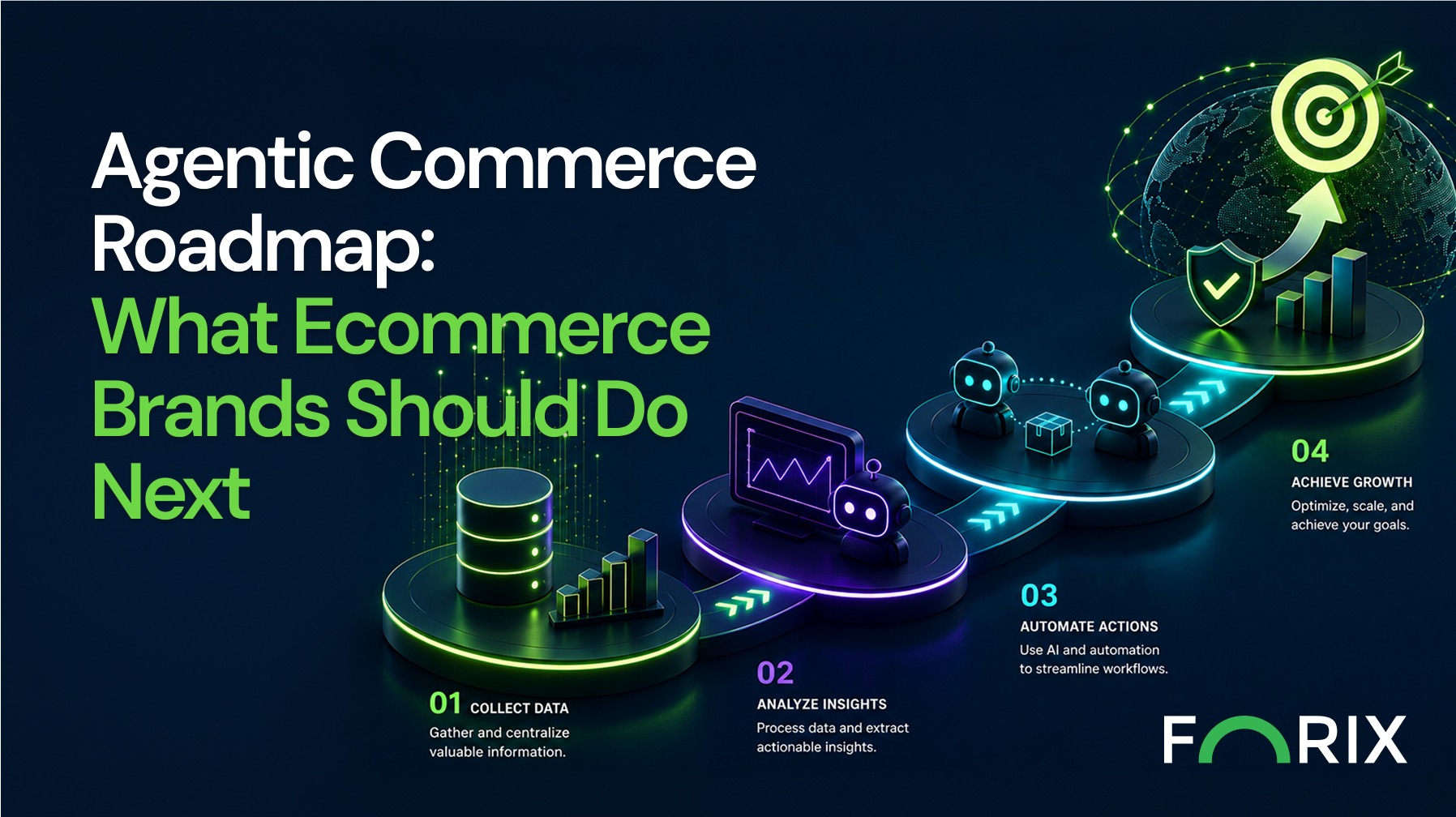
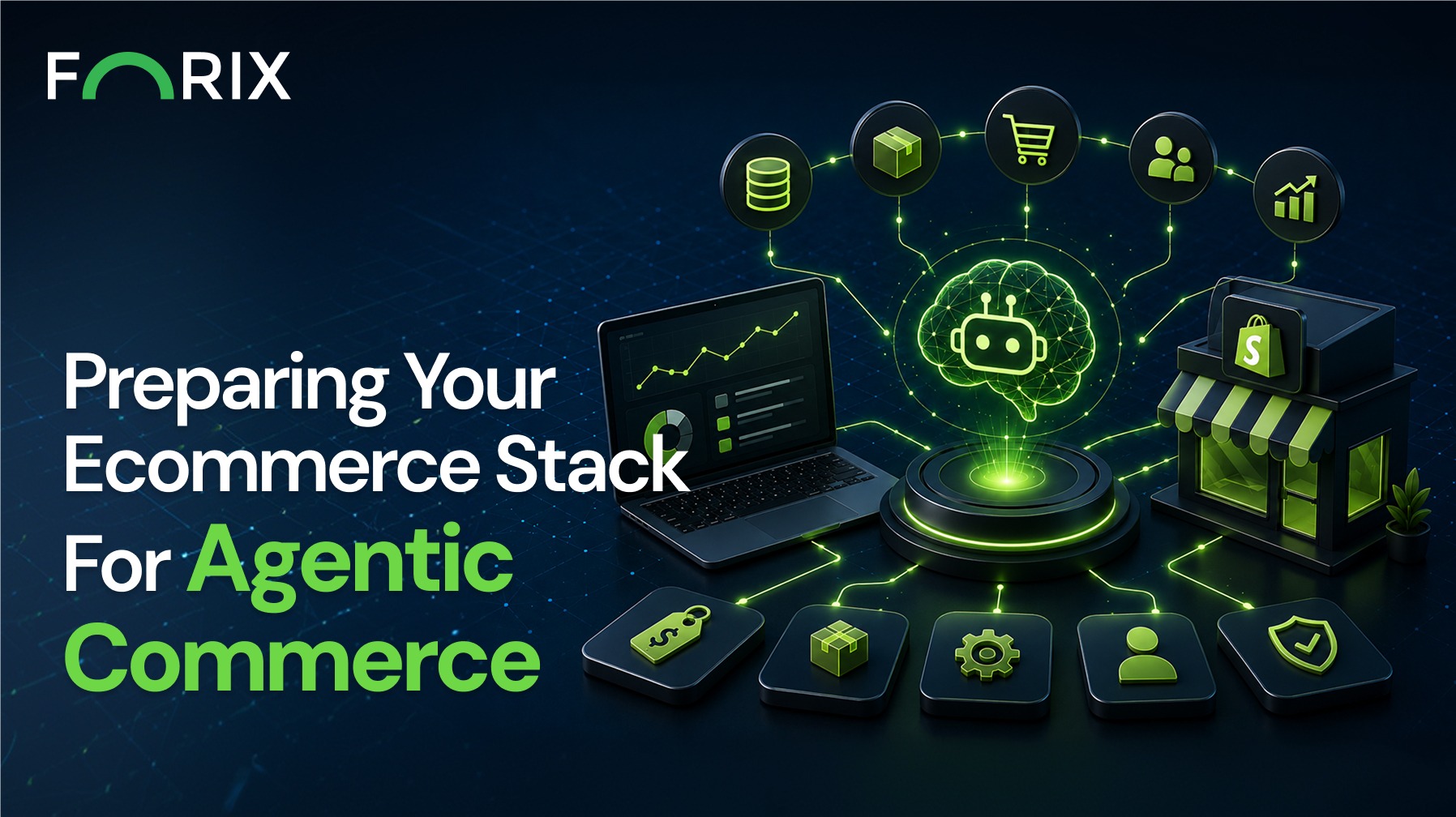
Agentic Commerce has moved from concept to execution. Ecommerce leaders now face a more practical question. What should we do next, and in what order. Without a clear roadmap, teams risk over investing in tools, under preparing data, or introducing autonomy before governance is ready.
Forix approaches Agentic Commerce as a staged transformation rather than a single initiative. This roadmap outlines a practical sequence for reducing risk, building confidence, and delivering value at each step.
Explore Forix’s Technology services to build a Agentic Commerce roadmap, strengthen data and governance foundations, and scale AI initiatives with greater confidence.
Phase 1: Foundations and Data
Every successful Agentic Commerce program starts with strong foundations.
This phase focuses on data readiness, integration, and observability. Brands should align core definitions across:
Products
Pricing
Inventory
Customers
Orders
Ensure data pipelines are accurate, APIs are secure and documented, and key business goals are clearly defined. Phase 1 is about building a reliable foundation for future autonomy, not deploying agents.
Phase 2: Assistive and Semi-Agentic Systems
With foundations in place, brands can move into assistive and semi-agentic systems.
In this phase, AI supports decision-making without full execution. Examples include:
Pricing recommendations
Inventory reorder suggestions
Merchandising insights
Promotion planning support
Demand forecasting alerts
Humans review outputs and approve actions while agents operate within defined limits, such as adjusting prices within approved ranges or reordering inventory up to budget caps. This builds trust and delivers value with minimal risk.
Phase 3: Multi-Agent Coordination
As confidence grows, brands can introduce coordinated agentic systems.
Multiple agents manage related decisions across pricing, merchandising, inventory, and marketing. Coordination prevents one agent from optimizing at the expense of another. For example, pricing decisions account for inventory constraints and margin targets.
This phase requires stronger orchestration and shared goals. It also benefits from composable and headless architectures that allow agents to operate independently yet cohesively.
Multi-agent coordination is where Agentic Commerce begins to feel transformative rather than incremental.
Governance and Scaling
Scaling Agentic Commerce depends on governance.
Effective governance should include:
Defined agent permissions
Human approval thresholds
Budget and margin controls
Security and access management
Audit logs and decision history
Performance dashboards
Clear ownership and escalation paths
Governance also requires organizational alignment. Teams need to know who owns each system, who reviews performance, and how exceptions are escalated.
At scale, governance enables speed. Without it, autonomy creates friction instead of efficiency.
What “Success” Looks Like
Success in Agentic Commerce is measured by business outcomes, not autonomy alone.
For ecommerce brands, success may look like:
Less time spent on repetitive decisions
Faster pricing and inventory responses
Protected margins as automation increases
More relevant and consistent customer experiences
Clearer visibility into risk and performance
Most importantly, leaders trust the systems in place. Autonomy feels like an advantage, not a liability.
Final Recommendations for Leaders
Agentic Commerce is a journey, not a leap.
Start with readiness, not tools. Sequence autonomy deliberately. Invest in governance early. Treat adoption as a change management effort, not just a technical rollout.
Brands that follow a roadmap move faster in the long run because they avoid rework and rebuild trust along the way. At Forix, we help ecommerce leaders design roadmaps that fit their business, platforms, and teams.
Conclusion
A clear Agentic Commerce roadmap turns ambition into action. By progressing through foundations, pilots, coordination, and governance, ecommerce brands can unlock real value without unnecessary risk.
Forix can help you define thoughtful next steps with a tailored Agentic Commerce Roadmap.
From flat sales to explosive sales growth - here's what happens when you partner with Forix
Partnering with Forix was hands down the best decision I’ve made for my store. The
redesign completely
transformed my site — it looks like a million dollars, yet I paid only a fraction of
what I expected.
Even better, sales started climbing almost immediately. Their process was simple,
transparent, and
focused on results. I only wish I had done it sooner.
Sarah Mitchell,Owner
“The free website report from Forix opened our eyes to issues we didn’t even know were costing us sales. The recommendations were clear, actionable, and backed by data. After implementing just a few of their suggestions, we saw a noticeable lift in conversions within weeks. Forix didn’t just give us a report—they gave us a roadmap to growth.”
Lena Hoffman, Director of eCommerce
“The redesign was exactly what my business needed. Clean, mobile-friendly, and conversion-focused. Sales are up 35% since launch.”
Ethan Carter, Founder
“Forix made our Magento to Shopify migration completely stress-free. Every product, customer record, and integration was moved accurately, and the new store’s design is sleek and user-friendly. Our team can now focus on growing sales instead of worrying about technical issues.”
Emily Rivera, Head of Digital Operations
198%
Conversion increase
32%
Transaction increase
30%
Time on site increase
28%
Conversion increase
92%
Revenue increase
87%
Engagement increase
Ready to See the Difference?
Your next big sales boost could start with our free website report. Let us show you the
untapped
potential in your store.
Complete the form below and our team will reach out to get started.
Thank you!
We’ve received your request for a free website report. Our team will be in touch shortly to gather a few details so we can begin your site analysis.
Click Here To
Get My Free Website Report Now
Claim Your FREE Webpage Design and Sell More ASAP
Complete the form below and our team will reach out to get started.
Thank you!
We’ve received your request for a free webpage design. Our team will be in touch shortly to gather a few details so we can begin your page redesign.
Click Here To
Get My Free Webpage Design Now
Claim Your FREE Migration Assessment and Sell More ASAP
Complete the form below and our team will reach out to get started.
Thank you!
We’ve received your request for a free Magento-to-Shopify migration assessment. Our team will be in touch shortly to gather a few details so we can begin building your comprehensive migration plan.
Click Here To
Get My Free Migration Assessment Now
Claim Your FREE Site Report and Sell More ASAP (a $2,000 value).
Complete the form below and our team will reach out to get started.
Thank you!
We’ve received your request for a free website report. Our team will be in touch shortly to gather a few details so we can begin your site analysis.