



Quill Corp v. North Dakota (1992) was a Supreme Court decision that defined sales tax nexus. The decision stated that in order to charge state sales tax, a business must hold a physical tie to a state such as a storefront, warehouse, or employees. Nexus was also referred to as “sufficient physical presence.”
Once online sales became commonplace, states began to realize that nexus did not apply to most online sellers, resulting in a loss of revenue associated with online sales. As a result, more than 20 states drafted legislation intent on collecting online sales tax. South Dakota’s suit against Wayfair, Inc. was the first to reach the Supreme Court.
On June 21, 2018, the Court ruled in favor of the state in South Dakota v. Wayfair, Inc. and overturned the Quill ruling defining nexus as a purely physical concept. Now, online sellers with sufficient economic activity in these states were subject to state sales tax as well. In essence, this ruling established economic nexus and changed ecommerce rules in South Dakota.
Which States Have Passed Economic Nexus Laws
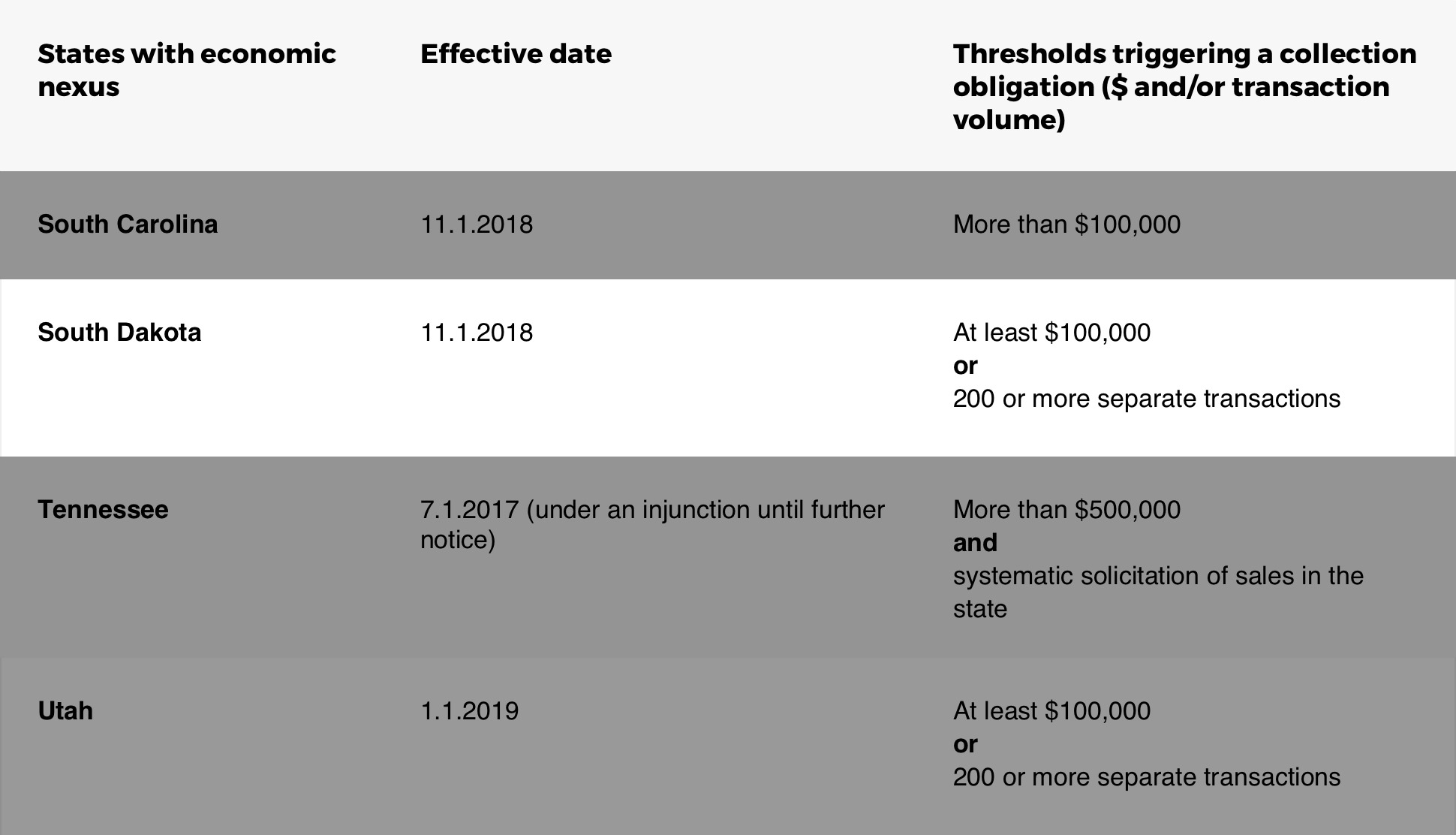
While South Dakota v. Wayfair Inc. was being decided, most other states that had passed similar laws did not enforce them, choosing only to enact their laws after the ruling took place. In the latter half of 2018, more states passed laws of their own, and still more are awaiting court action. Since the ruling, a total of 31 states have passed similar “South Dakota-style nexus laws”.
For a comprehensive list of all states with changes to economic nexus similar to South Dakota’s, see Avalara’s detailed chart here.
eCommerce Sales Tax Rules in South Dakota
Beginning November 1, 2018, online retailers known as remote sellers are subject to South Dakota state taxes under the laws passed on September 1st of that year. Specifically, in order for an online seller to collect sales tax online in South Dakota, one of the following thresholds must be crossed:
Revenue of more than $100,000
Two hundred or more separate transactions
South Dakota considers a business eligible for state taxes if it has met only one of these independent thresholds. If a seller grosses over $100,000 in revenue, they must charge and remit state taxes regardless of transaction numbers. Similarly, a remote seller with over 200 separate transactions is liable for state taxes regardless of revenue.
Do I Need to Charge Sales Tax on My Website?
You will need to charge sales tax on your website if you sell a tangible product, transfer a virtual product, or sell services in the state of South Dakota and meet one of the thresholds above. It is worth noting that although South Dakota’s laws were the impetus for the enforcement of other laws, the thresholds and effective dates vary by state. Using a professional service such as Avalara’s can help keep you up to date and streamline your sales tax among states.
Disclaimer: The information in this blog post is provided for general informational purposes only and should not be construed as legal advice from Forix or Avalara.
From flat sales to explosive sales growth - here's what happens when you partner with Forix
Partnering with Forix was hands down the best decision I’ve made for my store. The
redesign completely
transformed my site — it looks like a million dollars, yet I paid only a fraction of
what I expected.
Even better, sales started climbing almost immediately. Their process was simple,
transparent, and
focused on results. I only wish I had done it sooner.
Sarah Mitchell,Owner
“The free website report from Forix opened our eyes to issues we didn’t even know were costing us sales. The recommendations were clear, actionable, and backed by data. After implementing just a few of their suggestions, we saw a noticeable lift in conversions within weeks. Forix didn’t just give us a report—they gave us a roadmap to growth.”
Lena Hoffman, Director of eCommerce
“The redesign was exactly what my business needed. Clean, mobile-friendly, and conversion-focused. Sales are up 35% since launch.”
Ethan Carter, Founder
“Forix made our Magento to Shopify migration completely stress-free. Every product, customer record, and integration was moved accurately, and the new store’s design is sleek and user-friendly. Our team can now focus on growing sales instead of worrying about technical issues.”

Emily Rivera, Head of Digital Operations
198%
Conversion increase
32%
Transaction increase

30%
Time on site increase
28%
Conversion increase
92%
Revenue increase
87%
Engagement increase
Ready to See the Difference?
Your next big sales boost could start with our free website report. Let us show you the
untapped
potential in your store.
Complete the form below and our team will reach out to get started.
Thank you!
We’ve received your request for a free website report. Our team will be in touch shortly to gather a few details so we can begin your site analysis.
Click Here To
Get My Free Website Report Now
Claim Your FREE Webpage Design and Sell More ASAP
Complete the form below and our team will reach out to get started.
Thank you!
We’ve received your request for a free webpage design. Our team will be in touch shortly to gather a few details so we can begin your page redesign.
Click Here To
Get My Free Webpage Design Now
Claim Your FREE Migration Assessment and Sell More ASAP
Complete the form below and our team will reach out to get started.
Thank you!
We’ve received your request for a free Magento-to-Shopify migration assessment. Our team will be in touch shortly to gather a few details so we can begin building your comprehensive migration plan.
Click Here To
Get My Free Migration Assessment Now
Claim Your FREE Site Report and Sell More ASAP (a $2,000 value).
Complete the form below and our team will reach out to get started.
Thank you!
We’ve received your request for a free website report. Our team will be in touch shortly to gather a few details so we can begin your site analysis.