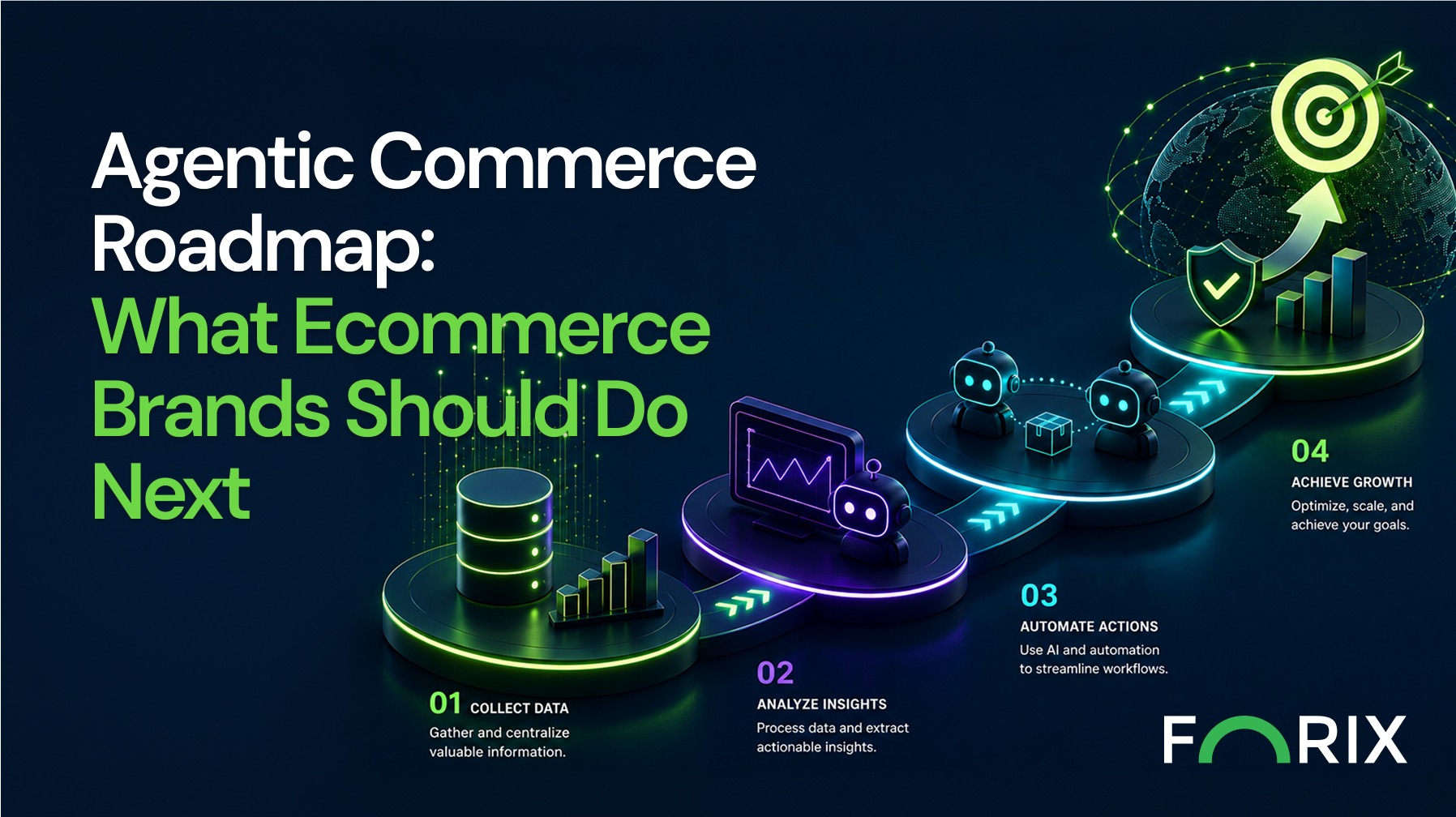
AI automation has become a standard part of modern ecommerce operations. From automated emails to demand forecasting and dynamic recommendations, most brands already rely on some form of AI driven tooling. Yet as ecommerce environments grow more complex, many teams are discovering that automation alone is no longer enough.
Agentic commerce represents the next step. It moves beyond automated execution into autonomous decision making.
Discover how Forix’s Technology services help ecommerce brands design and implement autonomous systems that drive smarter, faster decision making.
Why AI Automation Is No Longer Enough
AI automation is effective at executing predefined tasks at scale, reducing manual effort and improving consistency. However, ecommerce now operates in environments that change faster than static workflows can adapt.
Customer behavior shifts in real time. Inventory levels fluctuate daily. Competitive pricing dynamics evolve continuously. Systems limited to fixed rules struggle to respond at the required speed.
AI automation also depends on human input to interpret outputs, make decisions, and initiate actions. As data volume and complexity increase, this reliance becomes a bottleneck. This is where agentic commerce becomes relevant.
What AI Automation Does Well Today
AI automation remains a foundational capability for ecommerce organizations.
It performs reliably in structured, repeatable scenarios such as lifecycle email triggers, product recommendations, demand forecasting, fraud detection, and rules-based inventory alerts. When conditions are predictable, these systems deliver efficient outcomes.
Automation is also effective at generating insights by identifying patterns, surfacing anomalies, and recommending actions based on historical data. For many brands, this capability continues to provide meaningful value.
The limitation is one of scope, not capability. AI automation executes decisions; it does not own them.
What Makes Agentic Commerce Different
Agentic commerce introduces autonomy.
Rather than relying on predefined instructions, agentic systems are assigned goals and empowered to act within defined constraints. They observe data, evaluate tradeoffs, and determine actions independently.
Unlike traditional automation, agentic systems do not merely recommend changes. They execute decisions, measure outcomes, and adapt over time, extending teams by assuming responsibility for certain decisions.
Decision Making vs Rule Based Execution
The key distinction between AI automation and agentic commerce lies in decision ownership.
Rule-based automation focuses on execution. Once a decision is made, the system performs a predefined action when conditions are met.
Agentic commerce focuses on determining what to do next. It evaluates multiple options against objectives, selects the best course of action, and executes.
For example, automation may apply a discount when inventory exceeds a threshold. An agentic system would assess pricing, promotion timing, merchandising placement, and demand forecasts together to determine whether discounting is the optimal response.
This shift from execution to decision ownership enables more autonomous ecommerce operations.
When Ecommerce Brands Should Move Toward Agents
Not every ecommerce function requires an agentic approach. Brands should consider agentic commerce when decisions are frequent, time sensitive, and data intensive.
Indicators include teams spending excessive time interpreting dashboards, frequent manual overrides, or performance delays caused by slow response times. These signals suggest automation alone is no longer sufficient.
At Forix, we recommend starting with focused, high-impact use cases such as pricing optimization, merchandising prioritization, and inventory replenishment. With clear objectives and guardrails in place, agentic systems can operate in alignment with both brand and business priorities.
Conclusion
AI automation remains a critical part of ecommerce operations, but it is no longer the endpoint. Agentic commerce builds on automation by enabling systems to make and execute decisions at scale.
Understanding the difference helps ecommerce leaders invest wisely and avoid unnecessary complexity. The goal is not to replace automation, but to evolve it where autonomy creates measurable advantage. Get Your Free Site Report.
If you’re unsure where agentic commerce fits, the Forix team can help you think through where to start.
From flat sales to explosive sales growth - here's what happens when you partner with Forix
Partnering with Forix was hands down the best decision I’ve made for my store. The
redesign completely
transformed my site — it looks like a million dollars, yet I paid only a fraction of
what I expected.
Even better, sales started climbing almost immediately. Their process was simple,
transparent, and
focused on results. I only wish I had done it sooner.
Sarah Mitchell,Owner
“The free website report from Forix opened our eyes to issues we didn’t even know were costing us sales. The recommendations were clear, actionable, and backed by data. After implementing just a few of their suggestions, we saw a noticeable lift in conversions within weeks. Forix didn’t just give us a report—they gave us a roadmap to growth.”
Lena Hoffman, Director of eCommerce
“The redesign was exactly what my business needed. Clean, mobile-friendly, and conversion-focused. Sales are up 35% since launch.”
Ethan Carter, Founder
“Forix made our Magento to Shopify migration completely stress-free. Every product, customer record, and integration was moved accurately, and the new store’s design is sleek and user-friendly. Our team can now focus on growing sales instead of worrying about technical issues.”
Emily Rivera, Head of Digital Operations
198%
Conversion increase
32%
Transaction increase
30%
Time on site increase
28%
Conversion increase
92%
Revenue increase
87%
Engagement increase
Ready to See the Difference?
Your next big sales boost could start with our free website report. Let us show you the
untapped
potential in your store.
Complete the form below and our team will reach out to get started.
Thank you!
We’ve received your request for a free website report. Our team will be in touch shortly to gather a few details so we can begin your site analysis.
Click Here To
Get My Free Website Report Now
Claim Your FREE Webpage Design and Sell More ASAP
Complete the form below and our team will reach out to get started.
Thank you!
We’ve received your request for a free webpage design. Our team will be in touch shortly to gather a few details so we can begin your page redesign.
Click Here To
Get My Free Webpage Design Now
Claim Your FREE Migration Assessment and Sell More ASAP
Complete the form below and our team will reach out to get started.
Thank you!
We’ve received your request for a free Magento-to-Shopify migration assessment. Our team will be in touch shortly to gather a few details so we can begin building your comprehensive migration plan.
Click Here To
Get My Free Migration Assessment Now
Claim Your FREE Site Report and Sell More ASAP (a $2,000 value).
Complete the form below and our team will reach out to get started.
Thank you!
We’ve received your request for a free website report. Our team will be in touch shortly to gather a few details so we can begin your site analysis.