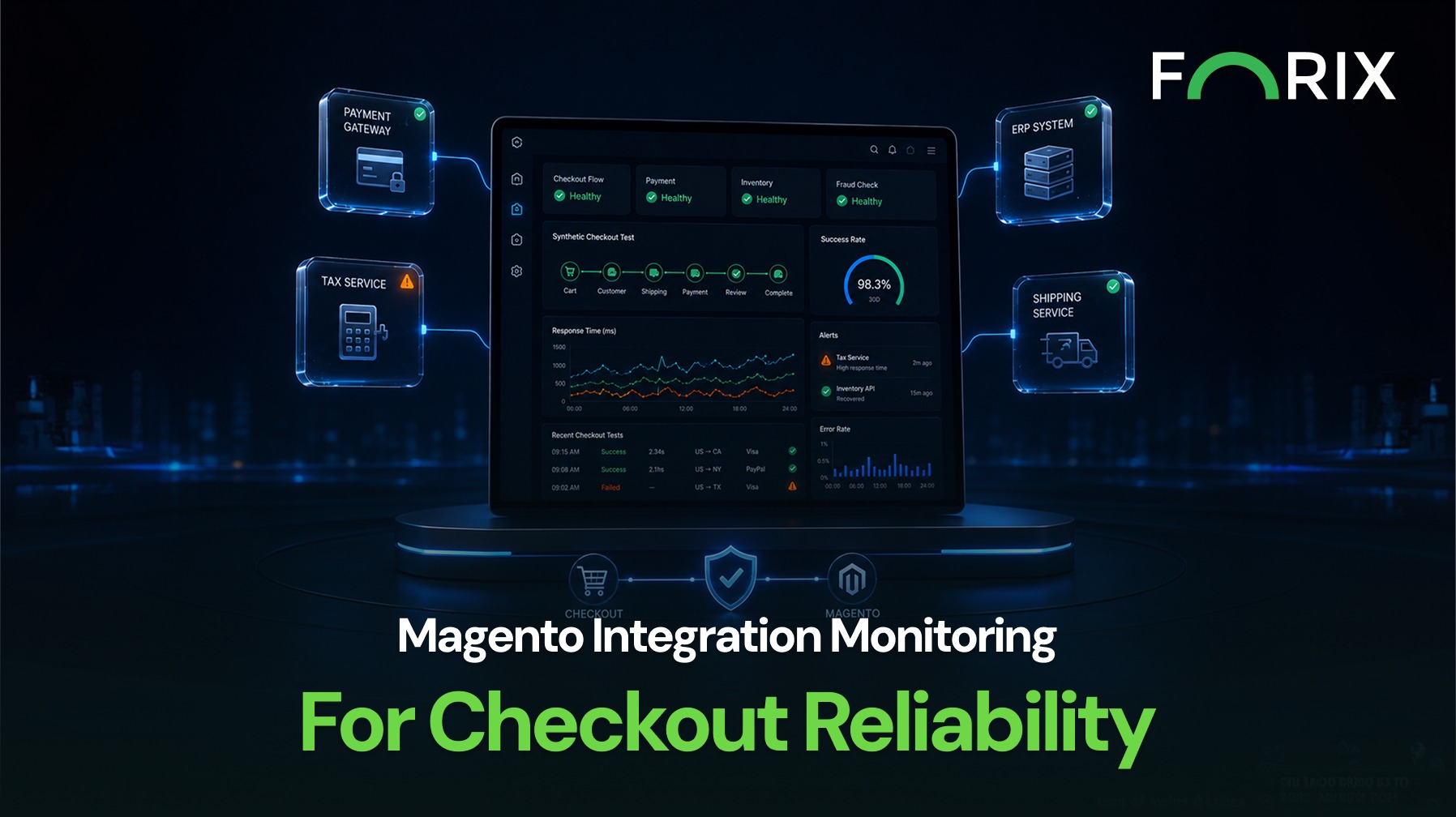
A Magento checkout can appear normal while a critical integration is beginning to fail. Product pages may load, carts may update, and customers may reach payment, yet a slow tax service, unavailable payment gateway, delayed inventory response, or failed shipping API can stop the order at the final step.
These failures are especially costly because they affect shoppers with strong purchase intent. Integration monitoring helps Magento retailers identify degraded services, failed requests, and unusual checkout behavior before the issue becomes a broader revenue problem.
Explore how Forix’s Magento services help retailers monitor critical integrations, investigate checkout failures, and maintain reliable purchasing experiences.
Why Checkout Reliability Depends on External Systems
Magento checkout often connects to several services outside the core platform. A single order may require responses from payment, fraud, address validation, tax, shipping, inventory, ERP, order management, and email systems.
The storefront can remain online even when one of these dependencies is unavailable. Traditional uptime monitoring may therefore report that the site is healthy while customers receive errors, incorrect totals, missing delivery options, or failed payment attempts.
Retailers need visibility into both platform availability and the outcome of the checkout process.
Map Every Critical Checkout Dependency
Effective monitoring begins with a clear integration map. Teams should document which services support each checkout step, what data is exchanged, and what happens when a service responds slowly or fails.
The map should identify:
Payment gateways and alternative payment methods.
Tax calculation and address validation services.
Shipping rates, delivery estimates, and pickup systems.
Inventory, ERP, and order management connections.
Fraud screening and authentication services.
Customer notifications and order confirmation workflows.
This creates a shared reference for technical teams and helps them prioritize the integrations with the greatest revenue impact.
Monitor Outcomes, Not Only System Uptime
An integration may technically remain available while returning incomplete data or taking too long to respond. Monitoring should therefore track business outcomes alongside infrastructure signals.
Useful checkout indicators include payment authorization failures, missing shipping methods, tax calculation errors, abandoned checkout sessions, API response time, webhook failures, queue backlogs, and orders that do not reach fulfillment systems.
Teams should also compare current behavior with a normal baseline. A sudden increase in one payment error or a sharp decline in completed orders may indicate an integration issue even when no service reports an outage.
Use Synthetic Checkout Tests
Synthetic testing simulates important customer journeys at scheduled intervals. It can verify that a shopper can add a product, enter an address, receive shipping and tax calculations, select a payment method, and reach the expected confirmation stage.
These tests should cover the most important checkout paths, including guest checkout, logged-in customers, mobile experiences, key regions, and commonly used payment methods.
Synthetic tests do not replace real-user monitoring, but they can reveal failures before customers report them.
Watch Queues, Webhooks, and Delayed Processes
Not every checkout failure appears immediately on screen. Magento may accept an order while a webhook, message queue, cron process, or downstream synchronization fails afterward.
Retailers should monitor whether orders reach the ERP or order management system, inventory updates complete, payment statuses remain synchronized, and confirmation messages are sent.
Delayed failures can create overselling, fulfillment gaps, duplicate work, and customer-service issues even when checkout initially appears successful.
Create Alerts With Clear Ownership
Alerts are useful only when the right team can act on them. Each critical integration should have an owner, severity level, escalation path, and expected response process.
Alert thresholds should be specific enough to identify meaningful changes without creating constant noise. Teams may prioritize sustained payment failures, repeated API timeouts, missing shipping methods, or a growing order-processing backlog.
Runbooks should document initial checks, vendor contacts, fallback options, and communication steps.
Review Failures as Conversion Data
Checkout integration monitoring should connect technical incidents with business impact. Teams should review affected sessions, payment methods, devices, regions, order values, and traffic sources.
This analysis helps retailers understand whether a failure affected a small edge case or a major customer segment. It also supports better prioritization for permanent fixes, vendor changes, and checkout improvements.
Conclusion
Magento checkout reliability depends on the complete network of services behind each order. Monitoring only site uptime can miss payment, tax, shipping, inventory, and order-processing failures that directly affect conversion.
Forix helps Magento and Adobe Commerce retailers map critical dependencies, monitor checkout outcomes, establish practical alerts, and investigate recurring failures. Strong integration monitoring gives teams the visibility and response structure needed to protect customer trust and revenue.
Can Magento checkout fail while the website remains online?
Yes. Product and cart pages can remain available while payment, tax, shipping, inventory, or other checkout integrations return errors or delayed responses.
Which Magento integrations should retailers monitor?
Critical integrations commonly include payment gateways, tax engines, shipping providers, address validation, fraud services, inventory systems, ERP platforms, order management systems, and customer notifications.
What checkout metrics should teams monitor?
Useful metrics include payment authorization failures, API response times, missing shipping methods, tax errors, checkout abandonment, webhook failures, queue backlogs, and orders that fail to reach fulfillment systems.
What is synthetic checkout monitoring?
Synthetic monitoring uses automated test journeys to verify that important checkout steps continue working. Tests can cover cart activity, address entry, tax, shipping, payment selection, and order confirmation.
How should teams respond to a checkout integration alert?
Each integration should have an assigned owner, severity level, escalation process, vendor contact, fallback option, and documented troubleshooting steps.
From flat sales to explosive sales growth - here's what happens when you partner with Forix
Partnering with Forix was hands down the best decision I’ve made for my store. The
redesign completely
transformed my site — it looks like a million dollars, yet I paid only a fraction of
what I expected.
Even better, sales started climbing almost immediately. Their process was simple,
transparent, and
focused on results. I only wish I had done it sooner.
Sarah Mitchell,Owner
“The free website report from Forix opened our eyes to issues we didn’t even know were costing us sales. The recommendations were clear, actionable, and backed by data. After implementing just a few of their suggestions, we saw a noticeable lift in conversions within weeks. Forix didn’t just give us a report—they gave us a roadmap to growth.”
Lena Hoffman, Director of eCommerce
“The redesign was exactly what my business needed. Clean, mobile-friendly, and conversion-focused. Sales are up 35% since launch.”
Ethan Carter, Founder
“Forix made our Magento to Shopify migration completely stress-free. Every product, customer record, and integration was moved accurately, and the new store’s design is sleek and user-friendly. Our team can now focus on growing sales instead of worrying about technical issues.”
Emily Rivera, Head of Digital Operations
198%
Conversion increase
32%
Transaction increase
30%
Time on site increase
28%
Conversion increase
92%
Revenue increase
87%
Engagement increase
Ready to See the Difference?
Your next big sales boost could start with our free website report. Let us show you the
untapped
potential in your store.
Complete the form below and our team will reach out to get started.
Thank you!
We’ve received your request for a free website report. Our team will be in touch shortly to gather a few details so we can begin your site analysis.
Click Here To
Get My Free Website Report Now
Claim Your FREE Webpage Design and Sell More ASAP
Complete the form below and our team will reach out to get started.
Thank you!
We’ve received your request for a free webpage design. Our team will be in touch shortly to gather a few details so we can begin your page redesign.
Click Here To
Get My Free Webpage Design Now
Claim Your FREE Migration Assessment and Sell More ASAP
Complete the form below and our team will reach out to get started.
Thank you!
We’ve received your request for a free Magento-to-Shopify migration assessment. Our team will be in touch shortly to gather a few details so we can begin building your comprehensive migration plan.
Click Here To
Get My Free Migration Assessment Now
Claim Your FREE Site Report and Sell More ASAP (a $2,000 value).
Complete the form below and our team will reach out to get started.
Thank you!
We’ve received your request for a free website report. Our team will be in touch shortly to gather a few details so we can begin your site analysis.