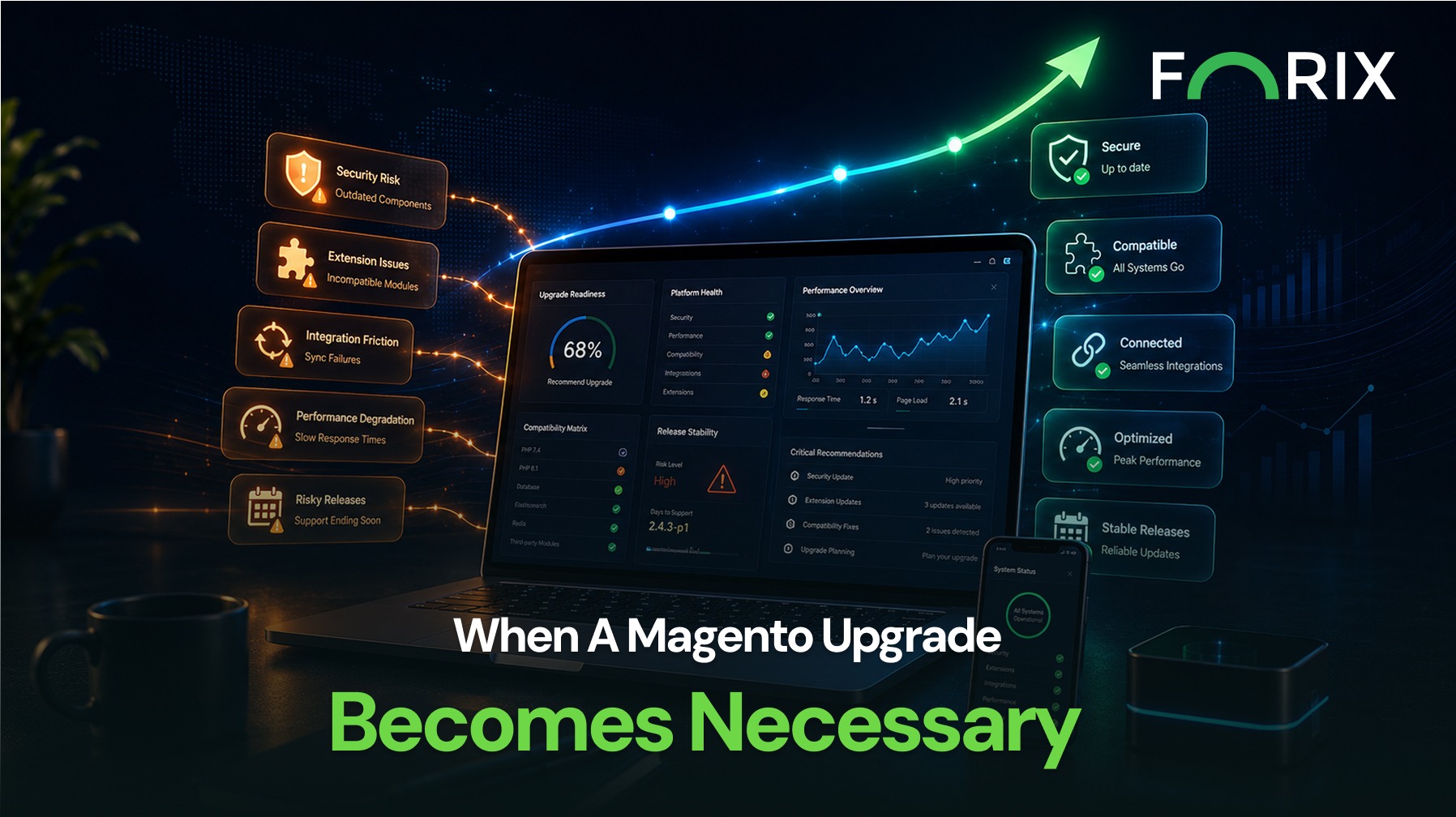
Magento upgrades are often postponed because the storefront still works. Orders continue to process, and customers can browse products. However, an upgrade usually becomes necessary before a complete failure occurs.
The strongest signal is not a single error. It is a pattern of growing security exposure, compatibility problems, performance limitations, and maintenance effort. When these issues affect customer experience or business priorities, waiting can become more costly than upgrading.
Explore how Forix’s Magento services help retailers assess upgrade readiness and plan stable, low-risk implementations before the current platform begins limiting growth or reliability.
An Upgrade Is a Business Decision
A Magento upgrade affects the storefront, custom code, extensions, integrations, hosting environment, and operational workflows. The decision should consider both technical condition and commercial impact.
Retailers should ask whether the current environment can support upcoming campaigns, catalog growth, customer experience improvements, and new integrations. A store may remain functional while becoming increasingly expensive or difficult to improve.
Security and Support Risks Are Increasing
An upgrade becomes urgent when the current environment cannot receive the security or compatibility updates the business requires. Delaying action can increase exposure to vulnerabilities and make future remediation more complicated.
Security concerns may affect payments, customer data, internal access, and compliance. Isolated patches can provide temporary protection, but they may not resolve the wider risks created by an aging environment.
Extensions and Integrations Are Harder to Maintain
Magento stores often depend on payment gateways, ERP systems, shipping services, tax tools, search platforms, and custom extensions. These systems change their requirements while the Magento environment stays the same.
Warning signs include unsupported extensions, failures after third-party changes, recurring synchronization errors, and vendors ending support for older configurations. When teams spend more time maintaining workarounds than improving the store, an upgrade assessment is justified.
Performance Problems Keep Returning
Performance issues do not always require an upgrade. Caching, infrastructure, media, database configuration, and custom code should be reviewed first. An upgrade becomes more relevant when problems return despite repeated optimization.
Older dependencies, accumulated customizations, inefficient extensions, and technical debt can restrict performance work. If page speed, indexing, checkout reliability, or administrative workflows remain inconsistent, the platform version may be part of the limitation.
Business Requirements Have Outgrown the Environment
Growth can make an upgrade necessary even when the store is stable. Larger catalogs, additional storefronts, new markets, complex promotions, B2B workflows, and expanding integrations may require capabilities the current environment cannot support efficiently.
The decision should connect directly to the roadmap. If major initiatives require extensive workarounds or cannot proceed without replacing core dependencies, upgrading may reduce long-term development effort.
Routine Changes Carry Too Much Risk
Another warning sign appears when ordinary releases become difficult. Small updates may require extensive regression testing, custom fixes, or emergency support. Teams may avoid important changes because they are uncertain what else will break.
This creates an operational bottleneck. Marketing, merchandising, and customer experience teams move more slowly because the platform cannot absorb change confidently.
How to Confirm Whether an Upgrade Is Necessary
Before committing to an upgrade, retailers should assess:
Current Magento version and available support.
Security patches and unresolved vulnerabilities.
Theme, extension, and custom-code compatibility.
Hosting, database, search, and PHP dependencies.
Critical integrations and data flows.
Performance, error, and incident history.
Business initiatives planned for the next 12 to 24 months.
The assessment should separate maintenance issues from problems that require an upgrade. It should also identify dependencies, testing requirements, and periods when deployment risk must be minimized.
Plan Before It Becomes an Emergency
A controlled upgrade starts with discovery, compatibility review, and a realistic roadmap. Teams should test in staging, validate critical customer journeys, confirm data integrity, and prepare rollback procedures.
Planning early gives retailers more control over timing, budget, and scope. Waiting until an unsupported component fails can turn a manageable project into urgent recovery work.
Conclusion
A Magento upgrade becomes necessary when the current environment creates increasing risk, blocks business priorities, or requires excessive effort to maintain. The decision should be based on evidence, not simply platform age.
Forix helps Magento and Adobe Commerce retailers assess upgrade readiness, identify dependencies, and build practical implementation plans. A well-timed upgrade can strengthen security, improve maintainability, and support future growth.
How do I know whether my Magento store needs an upgrade?
Common warning signs include increasing security exposure, unsupported extensions, recurring integration failures, persistent performance problems, and routine releases becoming difficult or risky.
Does poor Magento performance always mean an upgrade is required?
No. Retailers should first review caching, hosting, database configuration, media, extensions, and custom code. An upgrade may be necessary when performance problems continue despite targeted optimization.
Can Magento maintenance replace a full upgrade?
Maintenance can resolve patches, bugs, configuration problems, and some performance issues. It cannot always address unsupported dependencies, platform limitations, or compatibility problems tied to an older environment.
What should be reviewed before planning a Magento upgrade?
The assessment should cover the Magento version, security status, custom code, themes, extensions, integrations, hosting environment, data flows, performance history, and future business requirements.
How can retailers reduce risk during a Magento upgrade?
Retailers should complete compatibility reviews, use a staging environment, test critical customer journeys, validate data integrity, prepare rollback procedures, and avoid launching during major sales periods.
From flat sales to explosive sales growth - here's what happens when you partner with Forix
Partnering with Forix was hands down the best decision I’ve made for my store. The
redesign completely
transformed my site — it looks like a million dollars, yet I paid only a fraction of
what I expected.
Even better, sales started climbing almost immediately. Their process was simple,
transparent, and
focused on results. I only wish I had done it sooner.
Sarah Mitchell,Owner
“The free website report from Forix opened our eyes to issues we didn’t even know were costing us sales. The recommendations were clear, actionable, and backed by data. After implementing just a few of their suggestions, we saw a noticeable lift in conversions within weeks. Forix didn’t just give us a report—they gave us a roadmap to growth.”
Lena Hoffman, Director of eCommerce
“The redesign was exactly what my business needed. Clean, mobile-friendly, and conversion-focused. Sales are up 35% since launch.”
Ethan Carter, Founder
“Forix made our Magento to Shopify migration completely stress-free. Every product, customer record, and integration was moved accurately, and the new store’s design is sleek and user-friendly. Our team can now focus on growing sales instead of worrying about technical issues.”
Emily Rivera, Head of Digital Operations
198%
Conversion increase
32%
Transaction increase
30%
Time on site increase
28%
Conversion increase
92%
Revenue increase
87%
Engagement increase
Ready to See the Difference?
Your next big sales boost could start with our free website report. Let us show you the
untapped
potential in your store.
Complete the form below and our team will reach out to get started.
Thank you!
We’ve received your request for a free website report. Our team will be in touch shortly to gather a few details so we can begin your site analysis.
Click Here To
Get My Free Website Report Now
Claim Your FREE Webpage Design and Sell More ASAP
Complete the form below and our team will reach out to get started.
Thank you!
We’ve received your request for a free webpage design. Our team will be in touch shortly to gather a few details so we can begin your page redesign.
Click Here To
Get My Free Webpage Design Now
Claim Your FREE Migration Assessment and Sell More ASAP
Complete the form below and our team will reach out to get started.
Thank you!
We’ve received your request for a free Magento-to-Shopify migration assessment. Our team will be in touch shortly to gather a few details so we can begin building your comprehensive migration plan.
Click Here To
Get My Free Migration Assessment Now
Claim Your FREE Site Report and Sell More ASAP (a $2,000 value).
Complete the form below and our team will reach out to get started.
Thank you!
We’ve received your request for a free website report. Our team will be in touch shortly to gather a few details so we can begin your site analysis.