Shopify vs. BigCommerce vs. Magento: Which Ecommerce Platform Fits Your Business?
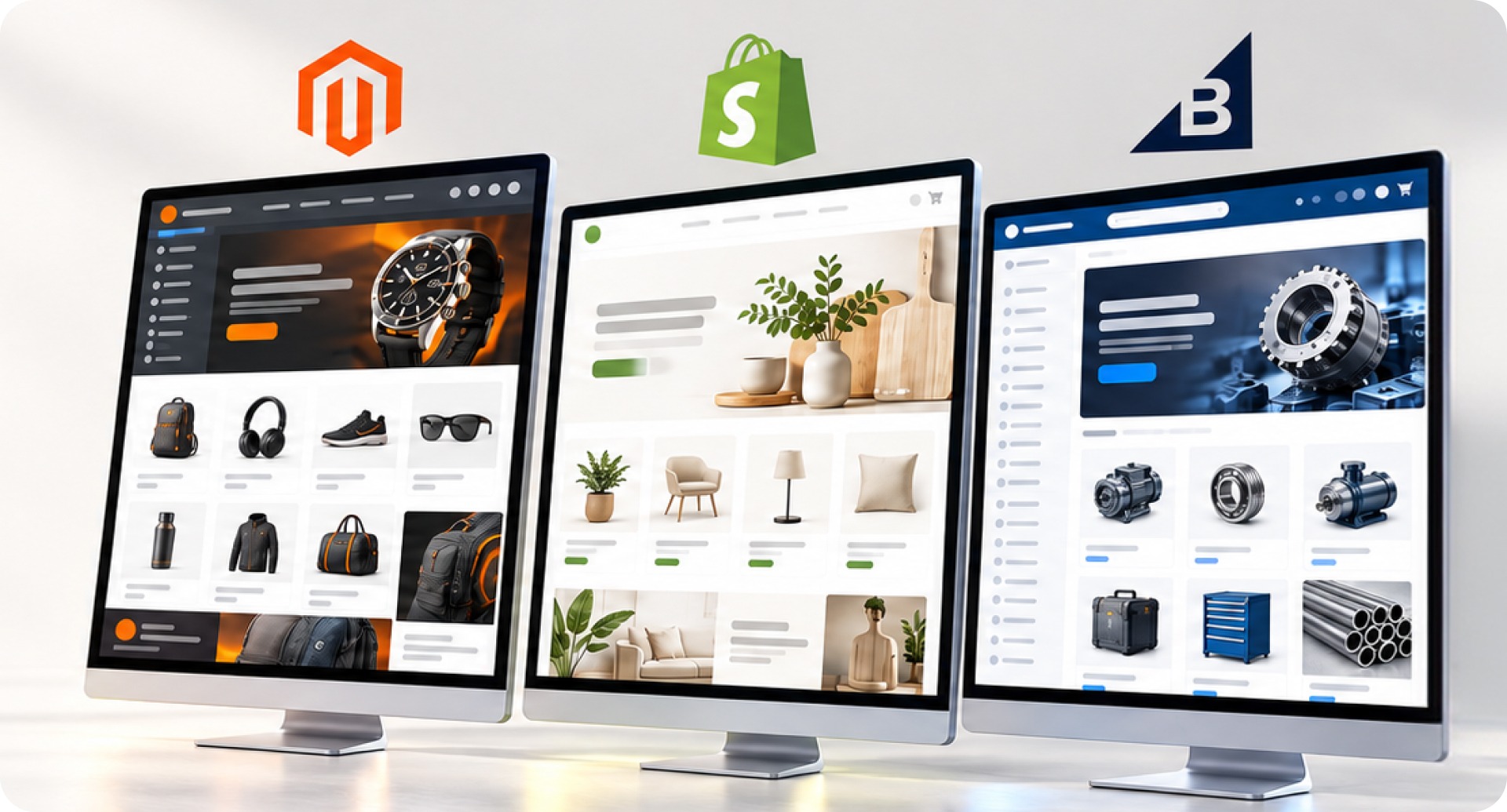
Shopify, BigCommerce, and Magento can all support sophisticated ecommerce operations, but they differ most in technical ownership, customization, B2B capabilities, integrations, and multi-store requirements.
The right choice depends on your business model, technical resources, integrations, and growth plans. Start with the quick comparison below, then explore the areas that matter most to your requirements.
Shopify vs. BigCommerce vs. Magento at a Glance
Use this table for the fastest comparison of the three platforms.
| Factor | Shopify | BigCommerce | Magento / Adobe Commerce |
|---|---|---|---|
| Platform Model | Hosted SaaS | Hosted SaaS | Open-source and commercial options |
| Technical Ownership | Lower | Lower | Higher with Magento Open Source |
| Customization | Apps, APIs, Functions, custom development | APIs, apps, integrations, custom development | Extensive code and architecture control |
| B2B | Native B2B, with capabilities varying by plan | B2B Edition | Advanced capabilities with Adobe Commerce |
| Multi-Store | Depends on requirements and architecture | Multi-Storefront | Multiple websites, stores, and store views |
| Headless | Supported | Supported | Supported |
| Pricing Model | Published subscription plans | Published subscription plans | No Magento Open Source license fee; customized Adobe Commerce pricing |
| Consider When | Managed infrastructure and ecosystem are priorities | SaaS flexibility, B2B, and multi-storefront are priorities | Extensive technical control is required |

Detailed Platform Comparison
Pricing & Total Cost of Ownership
Uses published subscription plans. Total cost can also include apps, integrations, custom development, payment processing, and higher-tier plans.
Uses published subscription plans. Cost can vary by plan, GMV, additional storefronts, integrations, and development requirements.
Magento Open Source has no software license fee, while Adobe Commerce uses customized pricing. Hosting, development, maintenance, extensions, and integrations affect total cost.
B2B Ecommerce
Supports native B2B, with capability depth varying by plan.
B2B Edition supports company accounts, quoting, invoices, buyer roles, and B2B purchasing
workflows.
Adobe Commerce supports company accounts, shared catalogs, custom pricing, quotes, quick ordering, and purchasing workflows.
Customization & Technical Ownership
Supports themes, apps, APIs, Shopify Functions, custom development, and headless storefronts within a managed SaaS environment.
Supports themes, APIs, apps, custom integrations, and headless storefronts while retaining managed SaaS infrastructure.
Provides extensive control over commerce functionality, architecture, integrations, and custom workflows, with greater development and maintenance responsibility.
Integrations
Combines its app ecosystem with APIs and custom integration options for external business systems.
Provides APIs, apps, and custom integration capabilities for business and operational systems.
Provides APIs, extensions, and custom integration options for complex business systems and
workflows.
International, Multi-Brand & Multi-Store Commerce
Supports international selling, while more complex multi-store and multi-brand setups depend on plan and architecture.
Multi-Storefront supports multiple storefronts from a single BigCommerce account.
Supports multiple websites, stores, and store views for different brands, regions, catalogs, and experiences.
SEO Capabilities
Provides core ecommerce SEO controls within its hosted platform. More specialized requirements
may depend on theme architecture, apps, custom development, or headless implementation.
Provides built-in ecommerce SEO functionality with additional customization available through themes, APIs, and custom development.
Provides extensive technical control over URLs, metadata, site architecture, international storefronts, and customized SEO implementations.
Payment Options
Offers Shopify Payments and supports third-party payment providers. Costs and transaction fees depend on plan and payment configuration.
Supports multiple payment providers, with available options and costs depending on merchant configuration.
Supports multiple payment integrations through platform capabilities, extensions, and custom development.
Security & Platform Responsibility
Manages much of the underlying platform infrastructure and platform-level security as part of its hosted SaaS environment.
Manages the underlying SaaS infrastructure and platform-level security within its hosted environment.
Magento Open Source gives merchants greater responsibility for hosting, security patches, infrastructure, extensions, and maintenance.
Which Platform Fits Your Requirements?
There is no single right platform for every business. Focus on the requirements your team actually needs to support.
Shopify
May fit when you need:
-
Managed SaaS infrastructure -
D2C and B2B capabilities -
Less direct infrastructure responsibility -
Custom or headless expansion
BigCommerce
May fit when you need:
-
Managed SaaS infrastructure -
B2B and wholesale capabilities -
Multi-Storefront -
API-driven integrations
Magento / Adobe Commerce
May fit when you need:
-
Extensive technical control -
Complex integrations or workflows -
Advanced B2B requirements -
Multi-site or multi-brand commerce

Beyond Platform Selection:
End-to-End Ecommerce Support
FAQs
We are here to ensure your brand delivers a best-in-class shopping experience.
Explore Our Work











Let’s Talk.
Start with a conversation. From there, we can build a plan.

Get instant insights to boost performance and sales.
Claim Your FREE Website Report and Sell More ASAP
Complete the form below and our team will reach out to get started.
Thank you!
We’ve received your request for a free website report. Our team will be in touch shortly to gather a few details so we can begin your site analysis.
Claim Your FREE Webpage Design and Sell More ASAP
Complete the form below and our team will reach out to get started.
Thank you!
We’ve received your request for a free webpage design. Our team will be in touch shortly to gather a few details so we can begin your page redesign.
Claim Your FREE Migration Assessment and Sell More ASAP
Complete the form below and our team will reach out to get started.
Thank you!
We’ve received your request for a free Magento-to-Shopify migration assessment. Our team will be in touch shortly to gather a few details so we can begin building your comprehensive migration plan.
Claim Your FREE Site Report and Sell More ASAP (a $2,000 value).
Complete the form below and our team will reach out to get started.
Thank you!
We’ve received your request for a free website report. Our team will be in touch shortly to gather a few details so we can begin your site analysis.